How to design eCommerce architecture for human and machine actors

Article summary
Instead of trying to predict what is coming, the only viable strategy is to build on a foundation that is ready for whatever comes next. This means designing an architecture that can gracefully adapt to any operational actor that needs to interact with your commerce engine.
The pace of change in eCommerce makes it impossible to predict what the market will look like in a few years. We do not know which new shopping channels, administrative tools, or automated systems will emerge. Trying to build a rigid platform to future-proof your business is a trap because the future keeps shifting.
Instead of trying to predict what is coming, the only viable strategy is to build on a foundation that is ready for whatever comes next.
This means designing an architecture that can gracefully adapt to any operational actor that needs to interact with your commerce engine. A customer service representative unblocking an order, a backend ERP integration syncing stock, and an automated script running a campaign all require different security models, confirmation patterns, and operational boundaries.
When you treat these distinct actors the same, your systems become fragile. Preparing for the unknown requires designing clear, isolated pathways for each one.
Actor one: the portal operator
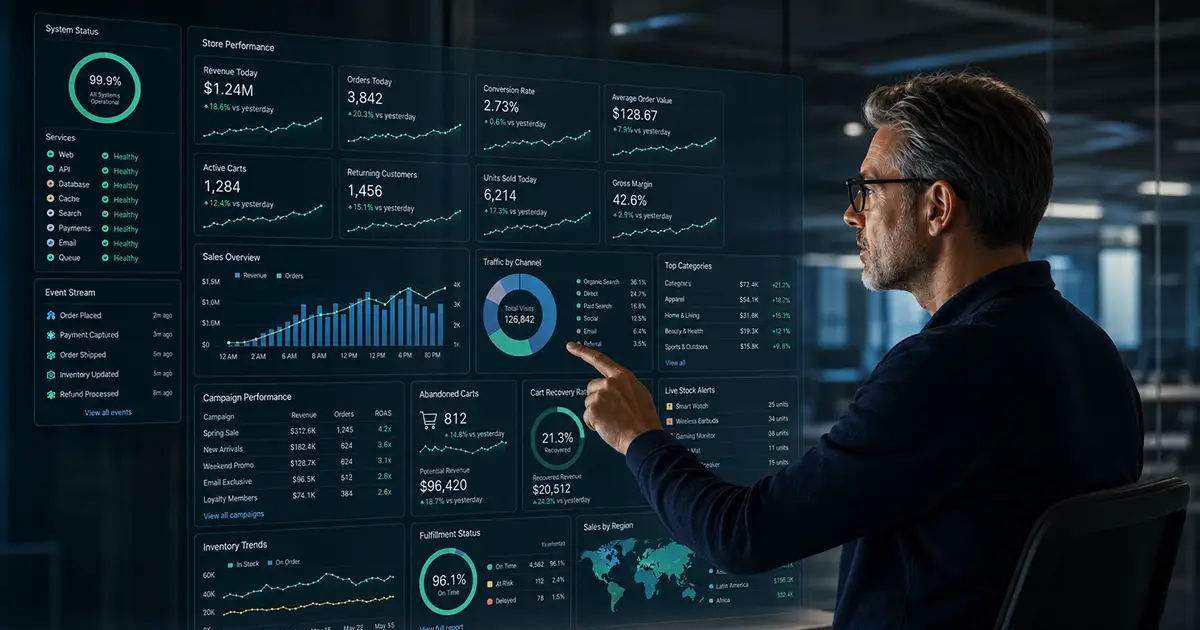
Human workflows and customer expectations change constantly. To keep operations agile, customer service and operations teams must be able to find information and act fast without impacting performance.
To support this human pathway, decouple your search and discovery from your core transactional database. By streaming data updates in the background to a dedicated search engine via a real-time event bus, portal operators can run complex, unpredictable queries. They can search for blocked orders, locate customer activity, or verify stock levels without putting any strain on your active checkout database.
Once operators have the data they need, they can safely execute immediate, clean actions:
- Order management: Update delivery addresses, modify order lines, adjust shipping fees, or process refunds, cancellations, releases, compensations, and modifications.
- Promotions: Configure campaign groups, discount rules, and discount codes. Note that Campaigns — time-bounded price rules — and Discounts — covering code-based rules, cart rules, and external rules — are distinct subsystems, each with their own configuration surface.
- Store setup: Configure store markets, manage inventory priority order per store market, and assign inventories.
To keep this pathway stable, establish strict operational boundaries. Stock quantity updates, for example, should never be made manually through a user interface. These must run solely via high-throughput machine APIs from your WMS or ERP. Keeping this separation ensures human operators always see a reliable state and never overwrite an active automated update.
Actor two: the automated ERP, WMS, or CRM integration
As your business grows, you will inevitably swap out or upgrade your core systems. You might change your ERP, connect a new shipping broker, or adopt a different CRM. To ensure these system changes do not break your entire stack, machine-to-machine integrations must run on a dedicated pathway.
This backend pathway should be secured using OAuth 2.0 client credentials with tightly scoped permissions — for example deliveries/write or orders/read — managed by the access-management service. Giving each system its own registered client identity ensures your ERP, WMS, and CRM only perform the exact tasks they require. This separates backend management from customer-facing checkout flows, which use a different security model: API keys for WAF-layer rate limiting and JWT bearer tokens for individual shopper sessions.
To ensure automated integrations remain resilient as systems evolve, build in two core mechanisms:
Asynchronous confirmation: An integration should never rely on immediate HTTP response codes alone. A resilient system streams detailed, named commerce events in real time using an event broker. When your ERP initiates a delivery, it listens for the confirming event before moving on. If the event does not arrive within a set window, it triggers a planned retry. This asynchronous pattern eliminates silent failures.
Strict error categorisation: Integrations need actionable feedback. By categorising errors into distinct, manageable buckets — payload errors, concurrency conflicts, rate limits, and internal system errors — your systems can decide instantly whether to reject a payload, retry immediately, back off gradually, or alert an engineer.
Actor three: the programmatic agent or operational script
The rise of automated, AI-native commerce means programmatic agents will increasingly run your day-to-day operations. These scripts update prices at the start of a campaign, rebalance stock across markets, or bulk-update order states. Because they act at machine speed across thousands of items, mistakes are exceptionally costly.
To prepare for this automated future, apply the same OAuth 2.0 client credential model to these scripts. Giving each script its own registered client with minimum required permissions is vital for tracking and containment.
Your system must maintain clear, structured logs and distributed tracing end-to-end across operations. Every post-checkout action on an order should be captured in an order activity log — recording whether the action was taken by a human operator (USER), an API integration (CLIENT), the system itself (BRINK), or an automated workflow (WORKFLOW), along with a timestamp and outcome. Troubleshooting becomes a simple lookup rather than a complex investigation.
Furthermore, use robust background workflow managers to coordinate multi-step processes across the full provider call chain — payment, shipping, gift cards, tax, and other provider integrations. If an external service fails mid-process, the workflow state is preserved and the failed step can be retried — or marked as manually handled or skipped — without restarting the entire operation from scratch.
The baseline: separating read and write pathways
To remain ready for whatever comes next, your architecture must maintain a clear division between database writes and search queries. In an event-driven backbone, every meaningful change publishes a domain event that downstream read services consume asynchronously — keeping transactional writes completely isolated from search and discovery queries. This separation is the ultimate foundation for adaptability.
A dedicated search and read layer ensures that neither your portal operators nor your automated scripts ever contend with checkout traffic. This keeps your transaction throughput predictable during high-velocity campaign drops, and ensures that read load from a busy operations team never slows down your checkout database.
Designing for adaptability
Operational friction is a design problem, not a technology problem. When every actor uses the same interface and access model, you cannot introduce new tools or automated scripts without impacting your core checkout.
By designing distinct, secure, and observable pathways for portal operators, automated integrations, and programmatic scripts, you build an eCommerce stack that remains stable, diagnosable, and ready for change.
This is why we built Brink Commerce. We did not build a monolithic box. Instead, we built a MACH Alliance-certified, headless and composable commerce platform. By separating read and write pathways, establishing strict machine-to-machine boundaries, and driving every meaningful change through real-time events, we made sure your technical teams get maintainable integration boundaries, your operations teams get a responsive portal, and your automated systems get the exact guardrails they need to run safely at scale.
When your architecture is designed for the actor rather than the average, you are finally ready for whatever comes next.
Enterprise eCommerce. Built for what's next.
Read next:




Want to know more about modern commerce?
Get in touch with us to get the discussion started?
Get in touch