Let's talk about how we can support you on your eCommerce journey. Submit your details below and we will get back to you as soon as possible. No strings attached.
We speak
Thank you! Your submission has been received!
Oops! Something went wrong while submitting the form.
Thank you! Your submission has been received!
Oops! Something went wrong while submitting the form.
Introducing the MCP for Merchant Portal: run your commerce operations through your own AI agent
June 18, 2026
Product News
We asked Claude to plan a Black Friday campaign.
The AI agent analysed last year's revenue, proposed six staggered campaigns across Nordic markets, and set up every single one of them directly through Brink Commerce APIs. It took about twenty minutes of skilled operator work and compressed it into a single, three-minute conversation. No code, no manual clicking through menus, and every action was cleanly recorded in the portal's audit log (read on to see it in action).
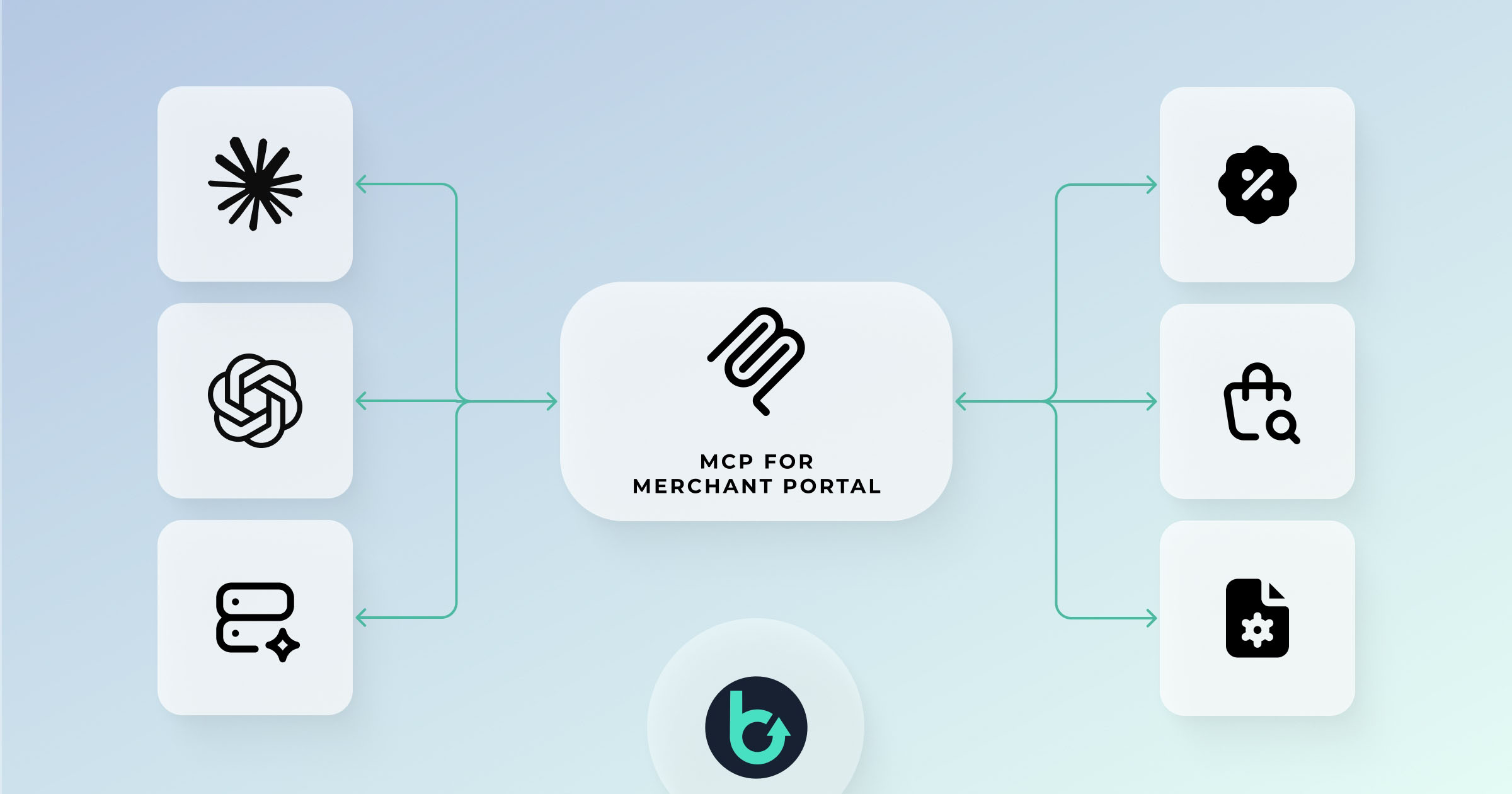
That is the MCP for Merchant Portal, a new capability rolling out to our merchants. It allows your operations teams to manage your entire commerce engine using natural language or autonomous agents. By connecting Claude, ChatGPT, or your own in-house AI framework, you can search orders, handle refunds, configure markets, adjust inventory rules, and manage campaigns without navigating a traditional admin interface.
The navigation tax on daily operations
Anyone running day-to-day eCommerce operations knows the familiar pattern. A simple customer inquiry like "why was this discount rejected at checkout?" kicks off a multi-step tour. You find yourself clicking from the rule editor to the order list, jumping over to the sales dashboard, and perhaps even running an ad-hoc API call to see what went wrong.
Each individual task is small, but the constant jumping between views is where your team's time actually goes. As an enterprise grows, this complexity multiplies. Every new market, currency, warehouse, and promotion rule adds more views to navigate and more potential failure points.
The MCP for Merchant Portal removes this friction. Instead of forcing your team to navigate to the work, it enables them to describe the work and let their agent execute it.
An open interface for any AI platform
MCP stands for Model Context Protocol. Developed and open-sourced by Anthropic, and has since been adopted by OpenAI and Google, it functions like a universal USB port connecting AI models to secure data and real-world systems.
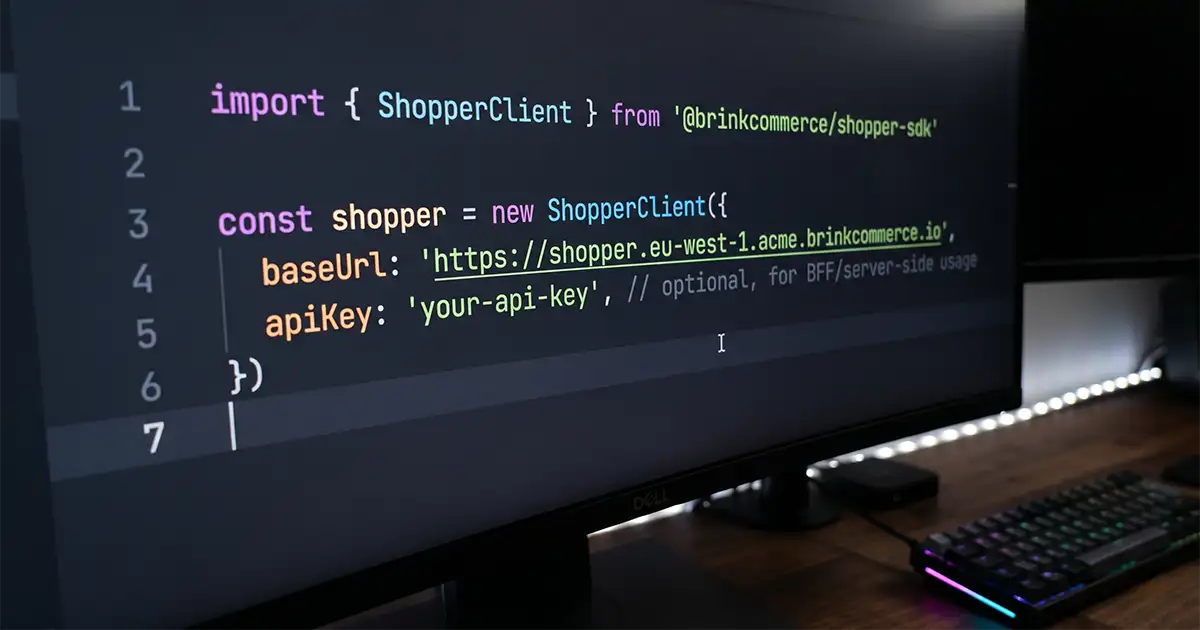
Because we built this on an open standard, there is no proprietary platform to adopt. If your business already uses Claude, ChatGPT, or a custom internal framework, you can connect it directly to Brink Commerce over HTTP and start working immediately.
This agentic interface works because Brink is built from the ground up as a headless, API-only system. Because all platform services are exposed as clean, modular endpoints, an AI agent can read, validate, and execute operations just like a human developer would.
"We did not want to build another closed-loop AI assistant," says John Osvald, CPO at Brink Commerce. "Merchants are already building their own internal tooling and choosing their preferred AI partners. By exposing Brink's Management and OMS APIs as typed, schema-defined tools, any standard-compliant agent can understand our system immediately. The agent does not have to guess payloads from documentation: it executes real, validated operations directly."
Not a chatbot
It is important to clarify what this is not. This is not a generic chatbot bolted onto a dashboard to summarise text. It is a highly secure, controlled execution plane.
"This is the part that standard AI demos usually skip," John explains. "You cannot let an autonomous agent roam free in an enterprise commerce database without guardrails. So we designed MCP to respect the exact same security architecture that governs our platform."
Role-scoped actions: Every command issued by an agent is restricted by the user roles and permissions configured in your Merchant Portal. If a user does not have permission to issue a refund in the UI, their agent cannot do it either.
Strict API validation: Every payload generated by the AI is strictly validated against our API schema before execution.
Complete auditability: Every single action taken by an agent is logged and attributed to a specific user and role. If an agent modifies a price or creates a discount, you can inspect the log to see exactly what was done, when, and why.
To show how this works in practice, we recorded two live sessions running against real Brink Commerce APIs over MCP. Together, they demonstrate the classic operational loop: observe what is happening, decide on a course of action, and execute.
1. Act: setting up campaigns
In the video at the top of this post, we tasked Claude with preparing our holiday promotion strategy. After analysing historical performance, the agent drafted a detailed, multi-market campaign plan. Once approved, the agent called the Brink Commerce Management API to construct the rules, markets, and dates automatically. What used to be a long configuration session is reduced to an audit review of a finished setup.
2. Observe and decide: diagnosing a conversion drop
In our second walkthrough, we focus on diagnostics and insights. By querying our shopper insights index, the operator asks the agent to analyse week-over-week activity.
[VIDEO: Finding conversion drops with Shopper Insights, 40s]
The agent runs live aggregations, identifies a fifty percent drop in activity, and isolates three products that were added to carts but abandoned. Crucially, it notes that two of those items are low on stock, and suggests a targeted, time-limited recovery campaign to run alongside our summer sale.
Because diagnostic tools and execution systems share the same interface, resolving the issue is as simple as replying: "Go ahead and set up that recovery promotion."
What your teams can do today
The MCP for Merchant Portal covers the full scope of your daily administrative tasks. Operations, customer service, and eCommerce teams can manage several key areas:
Orders and customer service: Search and filter orders, look up customer profiles, check product availability, and view active campaigns.
OMS operations: Create shipments, process refunds and cancellations, and move orders through custom state transitions.
Inventory management: Configure safety stock levels, adjust availability rules, and update inventory across warehouses.
Market expansion: Set up new store groups, establish local currencies, configure tax groups, and open new channels.
Campaigns and discounts: Create, modify, and monitor promotional rules.
Spotlight: streamlining discount operations
Discount management is inherently complex. Rules often conflict across markets, and small configuration errors can have immediate revenue impacts. Consequently, discounts are one of the most common sources of daily support inquiries.
MCP simplifies this complexity by condensing multi-step setups, testing, and diagnostics into direct statements:
Configuration
"Create code KLARA10K, capped at 10,000 SEK, calculated on regular price even during active campaigns, valid only on these SKUs."
"Set up a gift-with-purchase rule that adds the size-matched mystery item when cart total exceeds 1,200 SEK."
Simulation
"If a customer with the VIP tag adds four pairs of socks to their cart, which mystery variant is selected and what is the final cart total?"
"Show how stacked codes A and B combine on a 1,200 SEK checkout with express shipping in the Swedish market."
Diagnostics and reporting
"Why has discount code X been used more times than its usage limit?"
"Which discount rules are active right now in production, and which ones are scheduled to launch in the next seven days?"
Why this matters for the business
The immediate win is operational speed. Complex, repetitive workflows that used to require clicking through four different screens can now be completed in seconds. Issues are resolved faster, and operations teams spend less time on manual admin.
The strategic win is the path it creates toward automation.
Because MCP uses a single, open interface for both human instructions and machine inputs, it provides a natural path from assisted tasks to complete automation. A workflow that your team runs by hand today can easily be transitioned into a scheduled background script next month, and eventually into a fully autonomous agent.
You can make this transition gradually and safely, without rewriting code or changing your underlying API integrations. You gain the freedom to build your own operational assistants directly on top of Brink Commerce, keeping your technology stack flexible and ready for whatever comes next.
Availability
MCP access is rolling out to all Brink Commerce merchants. It can be enabled per user through a dedicated Merchant Portal role, allowing you to run testing in a staged environment before deploying to production.
The traditional Merchant Portal UI remains entirely unchanged.
About Brink Commerce
Founded in 2020 by Kristian Tysander, Marcus Ljungberg, and Patrik Antonsson, Brink Commerce offers a modern eCommerce platform built for forward-looking merchants and retailers. Designed to support fast growth and constant change, it enables seamless customer experiences, operational efficiency, and global scalability.
More Information
For more information or media querys, please contact Petter Johansson, CMO