Five ideas for implementing Agentic Commerce

Agentic commerce implementation - 5 ideas
Discover five practical ideas for implementing Agentic Commerce using Brink Commerce and new tech. Learn how to automate inventory guardrails, optimise campaigns, and use on-platform agents to scale your eCommerce operations with smart automation agents.
Discussions around event-driven and serverless architecture often stay theoretical. However, these technical choices become valuable when they solve specific merchant problems. If you are looking at how to implement agentic commerce, here are five ideas that connect business goals to automated event flows.
1. Automated inventory guardrails
The problem
Selling across multiple channels and warehouses leads to oversells when reservations and stock changes outpace the merchant’s view of available inventory. Often, WMS fulfilment failures arrive hours after the customer has already paid, leading to a poor experience and high support costs.
The idea
Use stock-management as the system of record and treat the existing OutOfStock, BackInStock, and ProductVariantInventoryStockUpdated events as the agent's signal feed. An agent can compute a per-SKU risk score from current stock, recent reservation velocity, and pending withdrawals. This allows the agent to react before the count actually hits zero.
How agents could help
When a SKU crosses a risk threshold, the agent attaches a blocking custom state with the operation DELIVERY to incoming orders containing that SKU. This gates the delivery step function so the order does not flow to the WMS until the agent or a human verifies inventory and removes the state. You can also drive this logic through the order-management workflow engine, which evaluates rules as soon as an order is created.
The potential outcome
Fewer order failures lead directly to higher customer satisfaction. Instead of receiving a cancellation email hours after their purchase, your shoppers get exactly what they paid for. This reliability builds long-term brand loyalty and significantly reduces the volume of support queries.
2. Potential for price experimentation in B2B and B2C
The problem
Testing new pricing strategies across different global markets is often slow. In B2B contexts, the complexity increases with customer-specific pricing and different tax regulations for each store group.
The idea
Price management services store prices and campaigns per market and currency. When a price is updated, it emits a price change event. Your search and shopper engines consume these events to stay in sync. By using separate store groups, you can isolate these experiments between B2C and B2B channels.
How agents could help
A pricing agent can test a new strategy for a specific variant in one market. It writes the price via the API and monitors conversion rates. Because Brink supports multi-market configurations from day one, the agent can roll out the successful price to other countries or store groups automatically once the experiment reaches its goal.
The potential outcome
Customers always see the right price at the right time, regardless of their location or segment. For the merchant, this means higher conversion rates through optimised pricing. For the customer, it ensures a fair and consistent experience that matches local market expectations.

3. Targeted campaign alignment with event filtering
The problem
Agents listening to every system change can quickly become overwhelmed by noise. Receiving every stock update for every SKU in every warehouse makes it difficult to focus on what matters for a specific marketing campaign.
The idea
Brink Commerce allows you to filter events at the source. This means you can configure your webhook destinations so that a campaign agent only receives the specific signals it needs, such as OrderCreated or StockUpdated for a limited set of high-priority SKUs.
How agents could help
A campaign agent follows these filtered events. If a hero product becomes unavailable, the agent automatically pauses related ads. Because the agent isn't being bombarded with redundant data from your entire catalog, it reacts faster and requires less processing power.
The outcome
Your marketing spend is more efficient, but the real winner is the customer journey. By ensuring that your advertisements never lead to a sold out page, you remove a major source of friction and frustration, keeping the brand promise intact from the first click.
4. Proactive order modifications through logistics signals
The problem
External systems often need to track an order’s progress. However, simply knowing an order is delayed is only half the battle; someone still has to fix the problem for the customer.
The idea
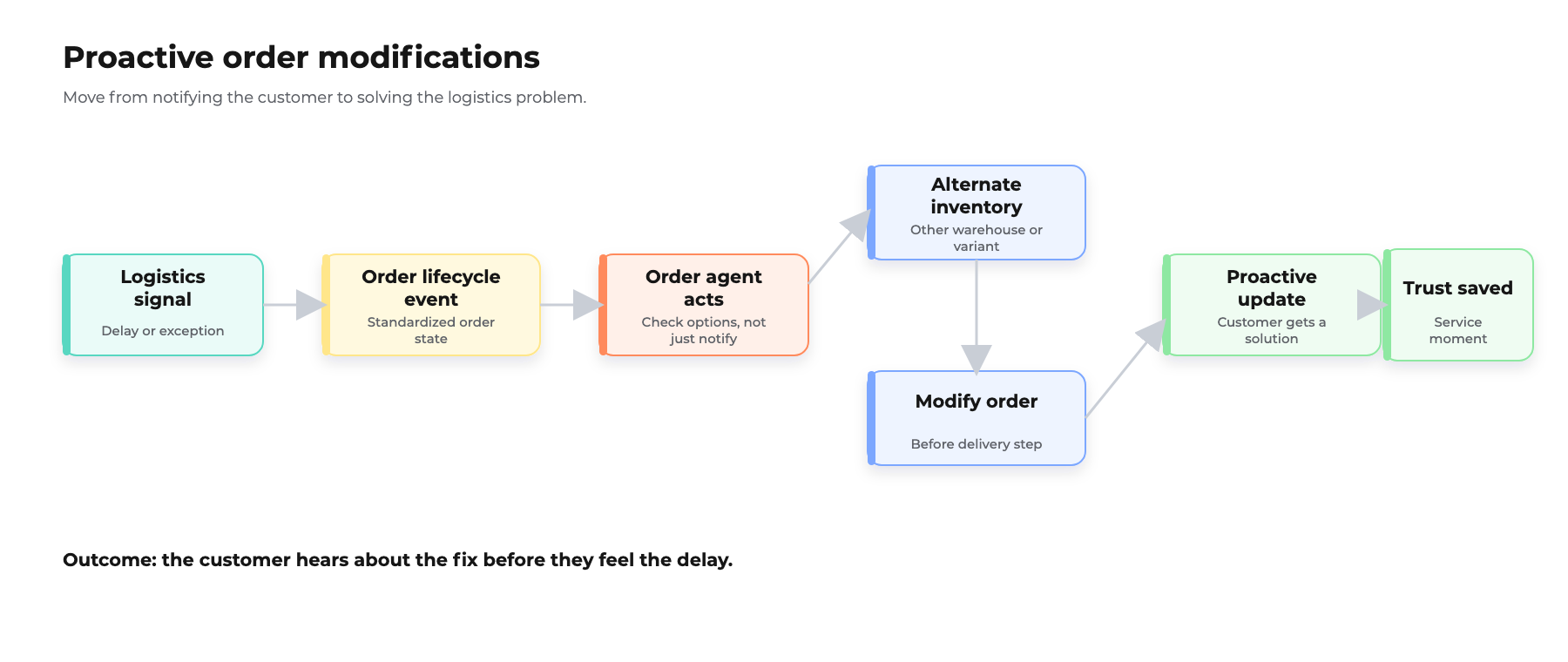
The order management engine emits standardised events for every stage of the lifecycle. When a delay is detected via a logistics signal, an agent doesn't just notify the team, it acts.
How agents could help
Brink allows for order modifications after an order is placed but before it is delivered. If a specific variant is delayed at one warehouse, an agent could check other inventories. It can then automatically remove the delayed line and add a different variant, or swap the item for an available one of the same value, keeping the customer informed throughout.
The potential outcome
You move from notifying to solving. Instead of the customer finding out about a delay when their package doesn't arrive, they receive a proactive solution, like a similar item or a faster shipping method, before they even feel the impact of the delay. This turns a logistics failure into a positive service moment.
5. Autonomous catalog enrichment and synchronisation
The problem
Keeping search indexes, PIM systems, and external marketplaces aligned with your main catalog is a constant struggle. Manual updates lead to inconsistencies, especially when dealing with complex product parents and numerous variants.
The idea
Your product management service acts as the source of truth. Every update to a product parent, variant, or addon emits a product event. Internal services, like search engines, use these signals to keep indexes current.
How agents could help
An enrichment agent listens for new product events. It validates attribute completeness and, if data is missing, it calls back into the Management API to update metadata. Because Brink Commerce uses machine-readable OpenAPI specifications, it is simple to build agents that understand exactly how to map this data to external marketplaces.
The potential outcome
A cleaner, more complete catalog leads to a better shopping experience. Customers find exactly what they are looking for through accurate search results and detailed product information. When the technical specifications and descriptions are always correct, you reduce the likelihood of returns caused by mismatched expectations.

Ready for what is next with Brink Commerce
These ideas for implementing agentic commerce are only possible when your foundation is built for flexibility. Traditional monolithic platforms often create barriers to automation through rigid databases and inaccessible data.
Brink Commerce enables agentic commerce by providing a modern, API-only architecture and, crucially, a built-in workflow engine. Because our system is headless and serverless, every action within the platform is an event that can be listened to. But the most powerful way to implement these ideas is through the internal order-management workflow engine. Using condition, branch, and action nodes on OrderCreated, you can build "on-platform" agents that react instantly to business needs.
By moving to a composable ecosystem, you take back control of your roadmap. You can experiment with new agents and automated flows at your own pace, ensuring your business is always ready for what is next.
Read next:




Want to know more about modern commerce?
Get in touch with us to get the discussion started?
Get in touch